EAR-04Edition 1.0 · November 2026
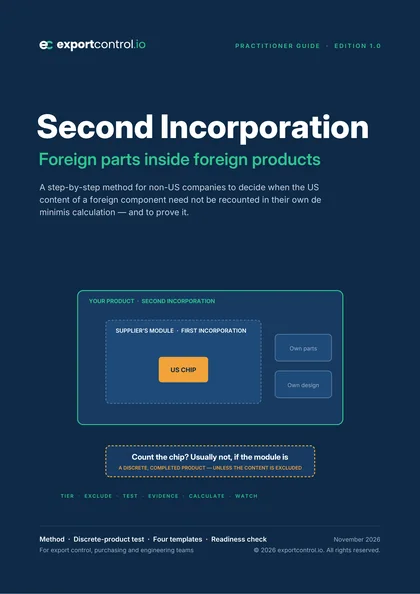
Second Incorporation
Foreign parts inside foreign products
A step-by-step method for non-US companies to decide when the US content of a foreign component need not be recounted in their own de minimis calculation — and to prove it.
What this guide settles
- Second incorporation is a BIS practice, not a rule written in the EAR — applied case by case, on the facts
- It applies only once a first incorporation has produced a distinct, completed foreign product
- An arm’s-length purchase or separate sale points to a discrete product; your role in its design, manufacture or parts points away
- It never covers ITAR, applicable zero de minimis, US-origin “600 series” or see-through content, and it must never be engineered
What you get
- The guide: explanations, method, conditions and limits
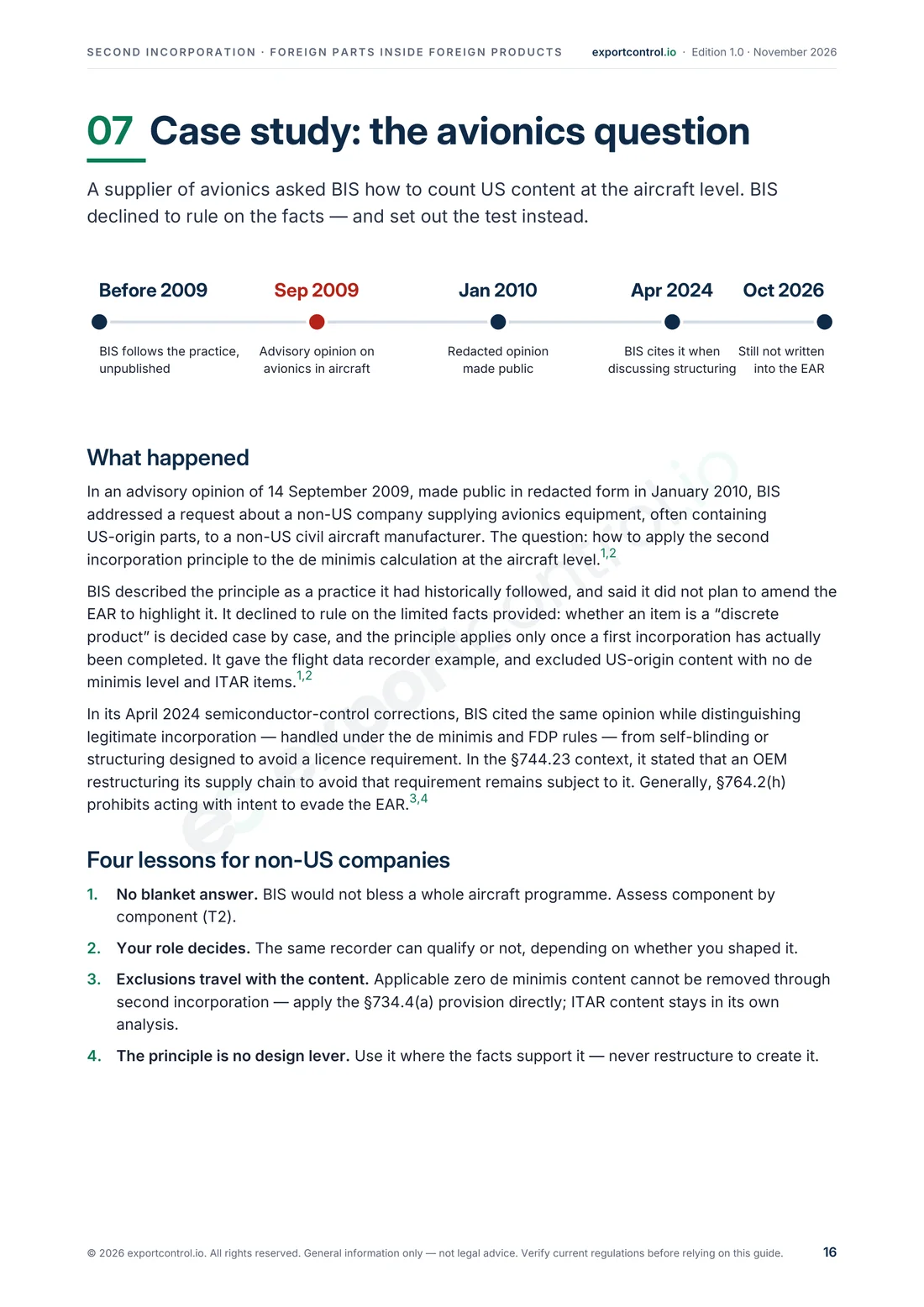
- Worked examples: the discrete-product test, the BIS advisory opinion commented and ten pitfalls
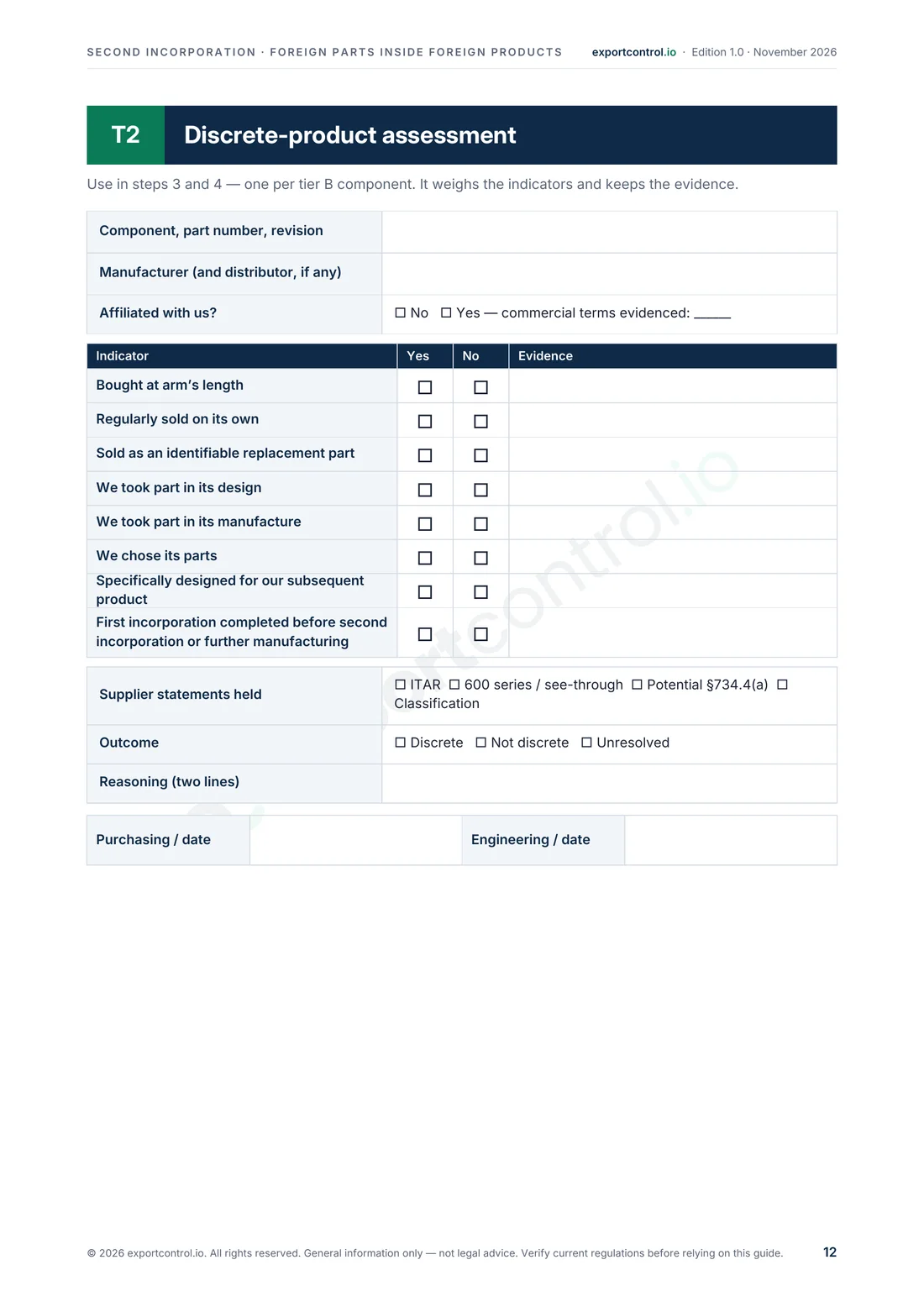
- Tools printed in the guide: four templates and a readiness check
- Sources with section references and their verification date
- Revisions included for 12 months
Printed tools: T1 · Component tiering sheet · T2 · Discrete-product assessment · T3 · Second incorporation record · T4 · Review triggers and change log · Readiness check
Contents
- Before you start: scope and limits
- Why second incorporation matters
- The rule in one page
- The discrete-product test
- The method in six steps
- Templates T1 to T4
- Ten pitfalls
- Case study: the avionics question
- Readiness check
What it does not cover
- The de minimis calculation itself
- Foreign direct product rules
- ITAR components
Assumed knowledge. Knowing how a de minimis calculation works, whether your product is foreign-made, and that foreign direct product rules are a separate route.
Sample pages
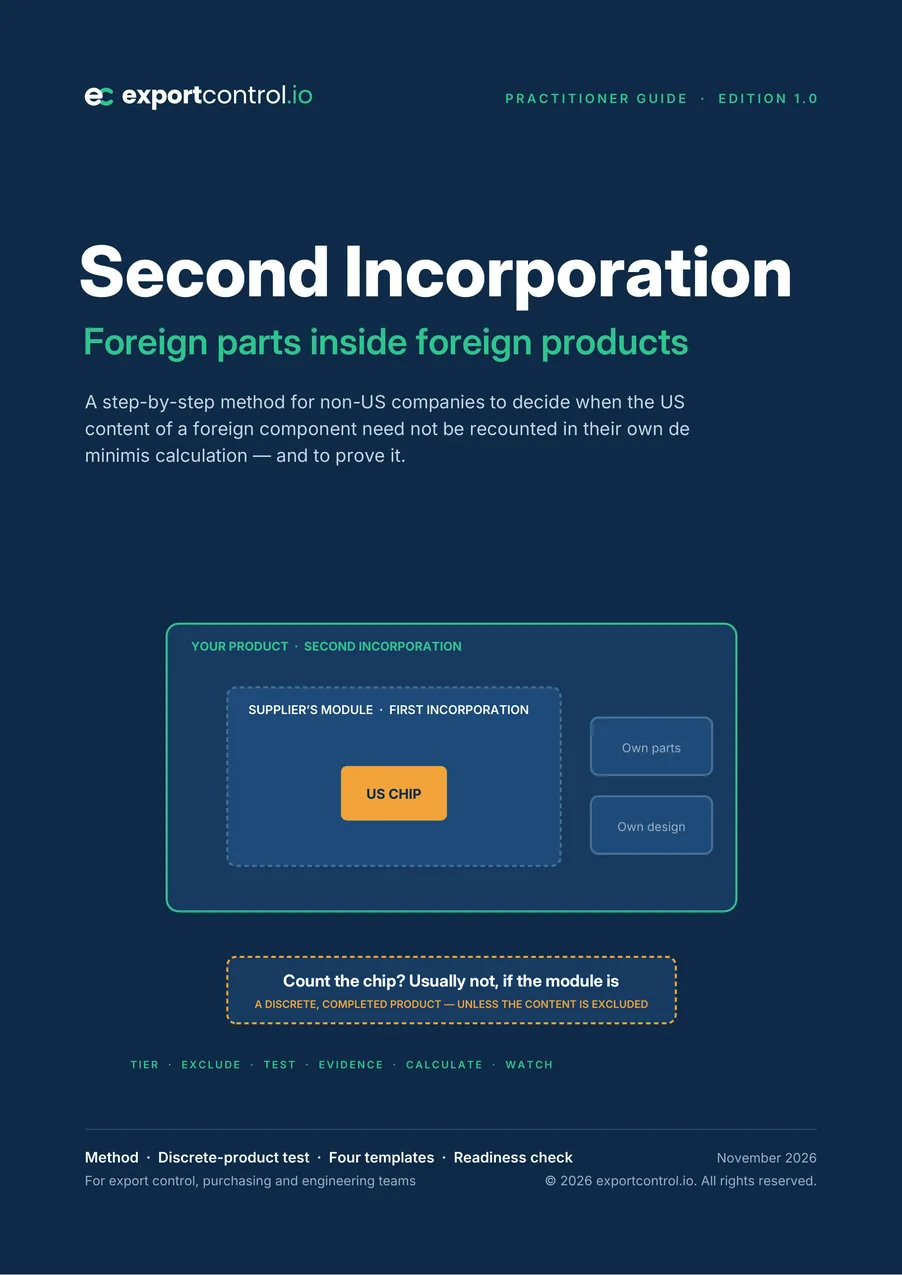
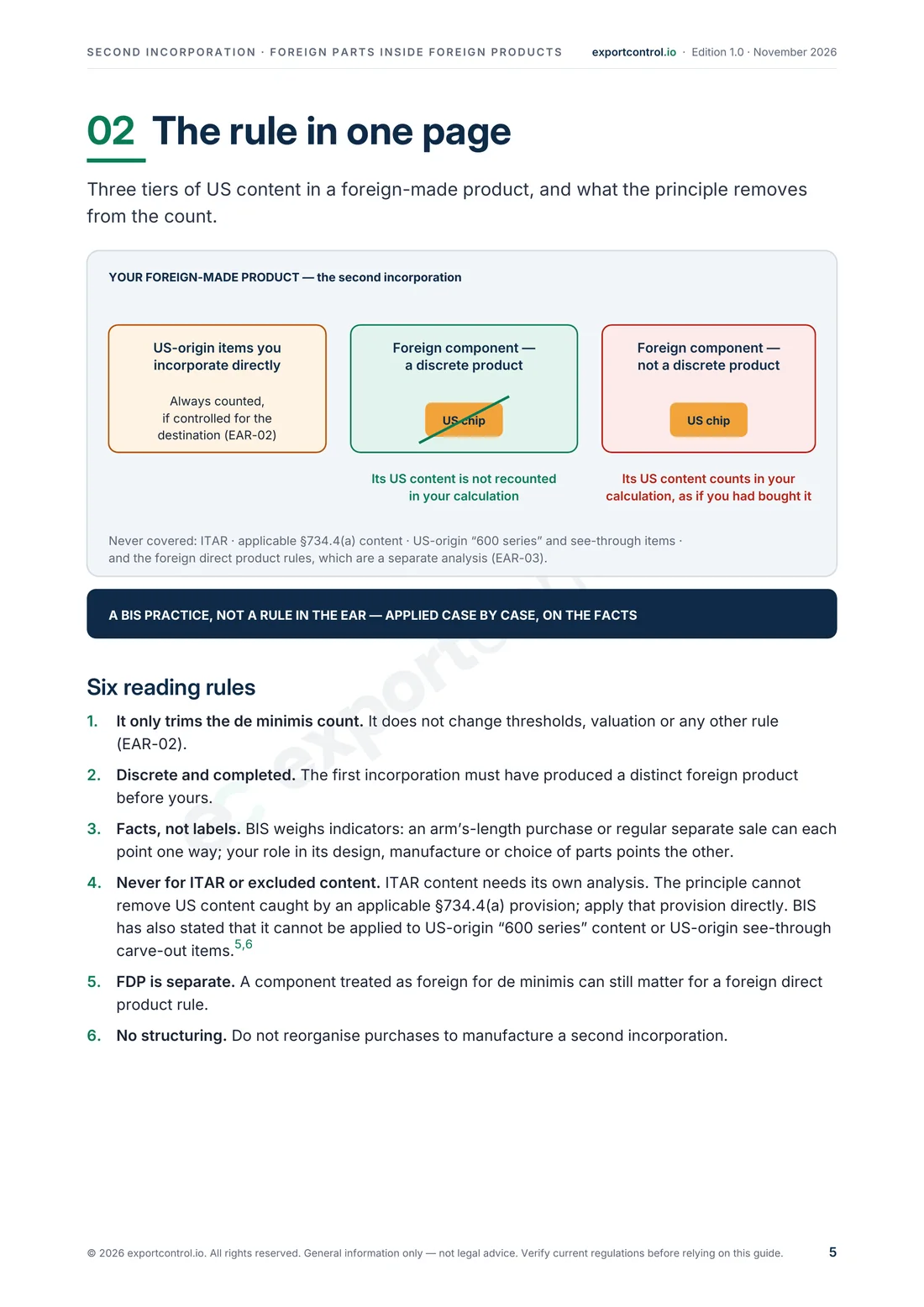
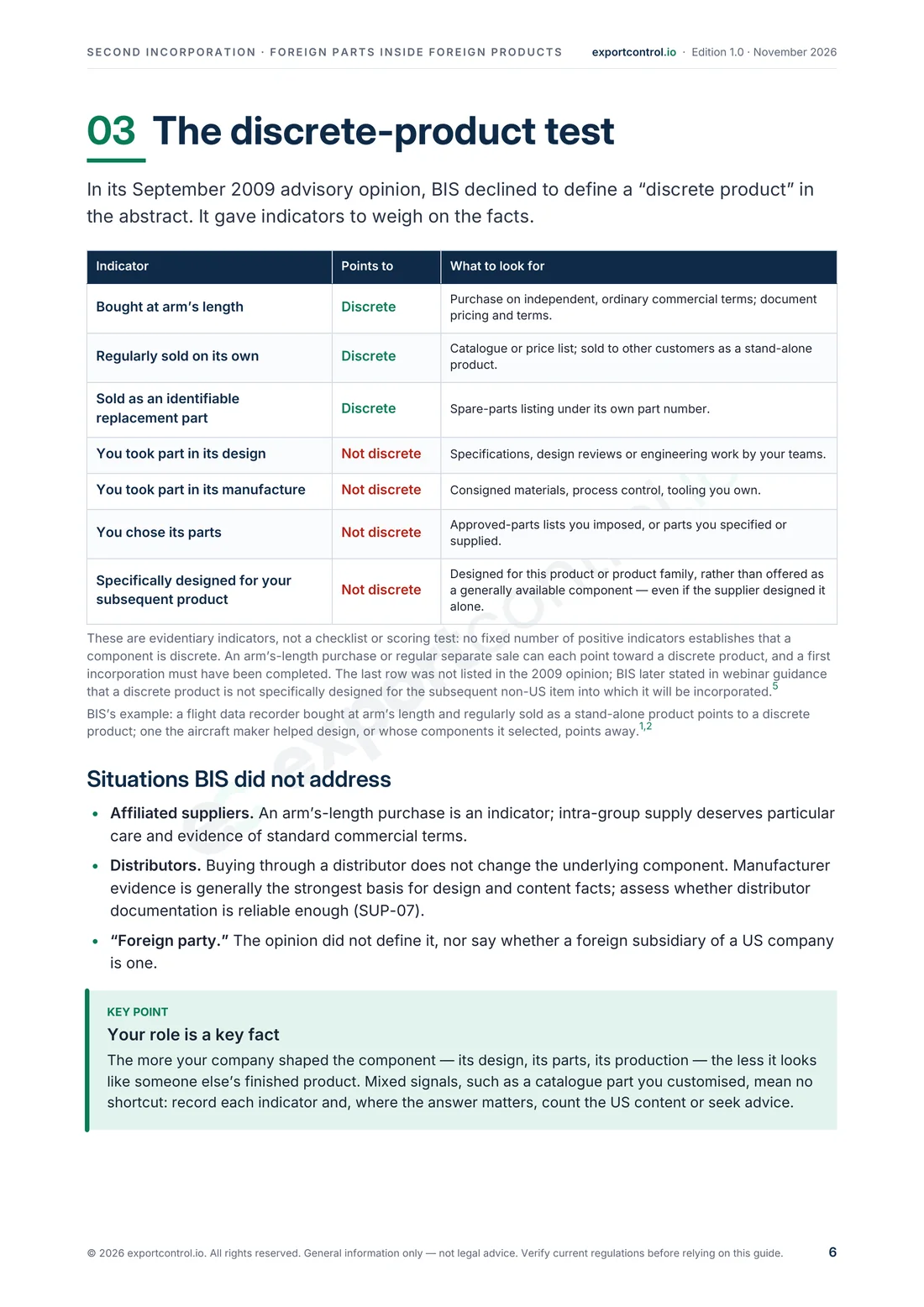
Open an image for the full-size page.
Where it connects
Part of a collection
Second Incorporation is one of the eight guides of EAR: Scope, Licensing & Exceptions (Understand the Rules), available together at €390 instead of €89 each.