SUP-08Edition 1.0 · November 2026
Supplier Changes, Substitutions & Reclassification
When something changes after you qualified the item
A step-by-step method for non-US companies that have classified an item and its supplier — to find out what a change of configuration, source, evidence or rules does to that analysis, what it does to the stock and to past operations, and what stays valid.
What this guide settles
- A change is an event to assess, not a reason to reclassify everything — its cause, chronology and population decide what still holds
- The same notice can mean the item changed, the rules changed, or the earlier analysis was wrong: three different consequences for the stock and for the past
- Separate the dates — material change, cut-in, notice, regulatory effective date, internal decision — and define the population: ordered, in transit, in stock, incorporated, delivered
- A new CCATS is read within its scope, a savings clause is a mechanism with conditions, an acquisition is not a name change (§750.7(c), §122.4) — and superseded evidence is kept, not deleted
What you get
- The guide: explanations, method, conditions and limits
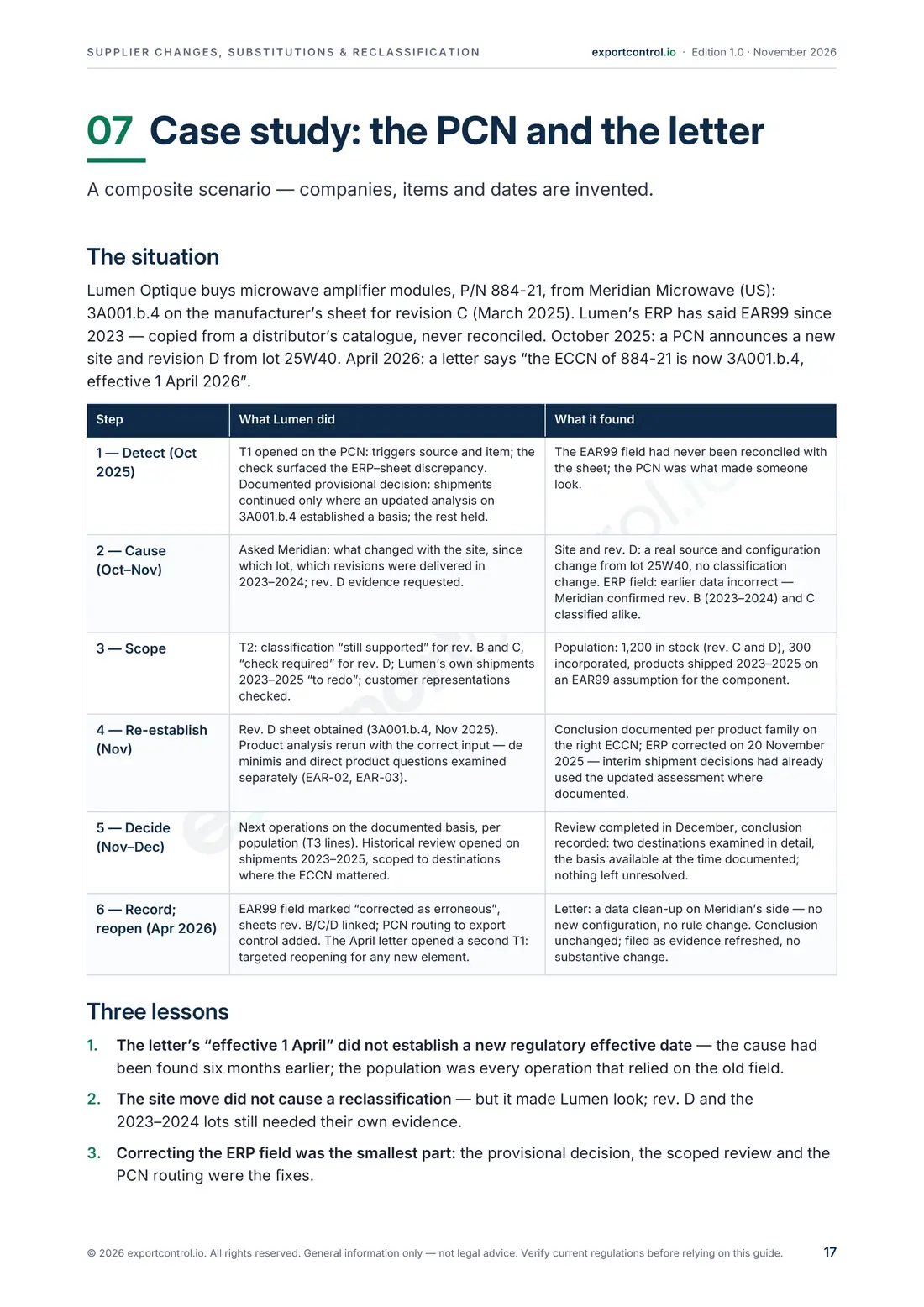
- Worked examples: five change triggers, the three explanations of a classification change, the dates and populations to separate, a documented savings clause, §750.7(c) and §122.4 read for a supplier change, the new evidence and what must not be inferred from it, a composite case and ten pitfalls
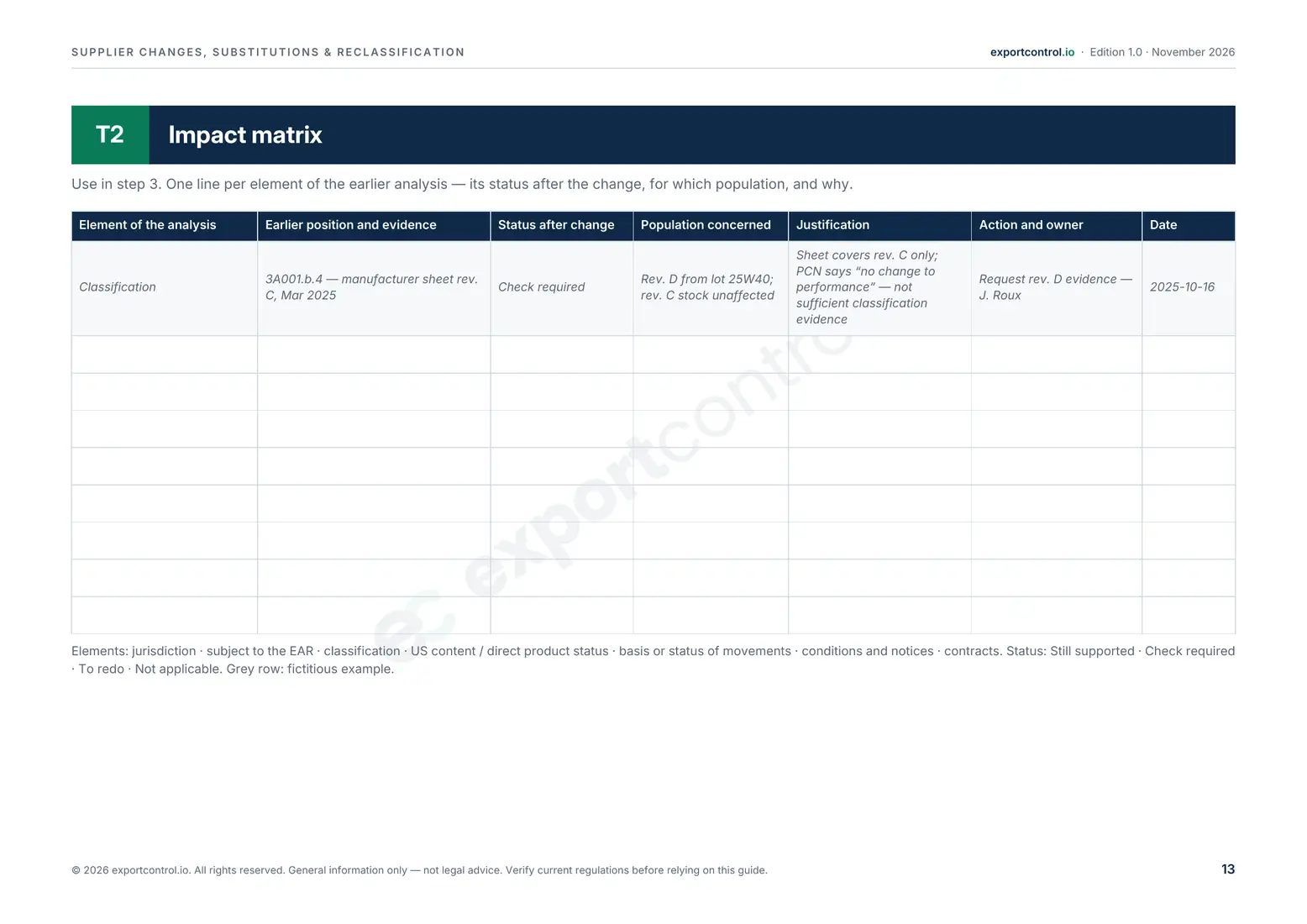
- Tools printed in the guide: four templates, including an impact matrix and a change assessment and decision record, and a readiness check
- Sources with section references and their verification date
- Revisions included for 12 months
Printed tools: T1 · Change intake sheet · T2 · Impact matrix · T3 · Change assessment and decision record · T4 · Supersession and watch list · Readiness check
Contents
- Before you start: scope and limits
- Why the change matters
- The rule in one page
- Dates, populations and what each regime does
- The method in six steps
- Templates T1 to T4
- Ten pitfalls
- Case study: the PCN and the letter
- Readiness check
What it does not cover
- Challenging the new classification itself
- Amending ITAR licences, agreements or registration
- Computing US content or foreign direct product status
Assumed knowledge. How to request and challenge classification information, and whether de minimis or direct product questions arise for your products.
Sample pages
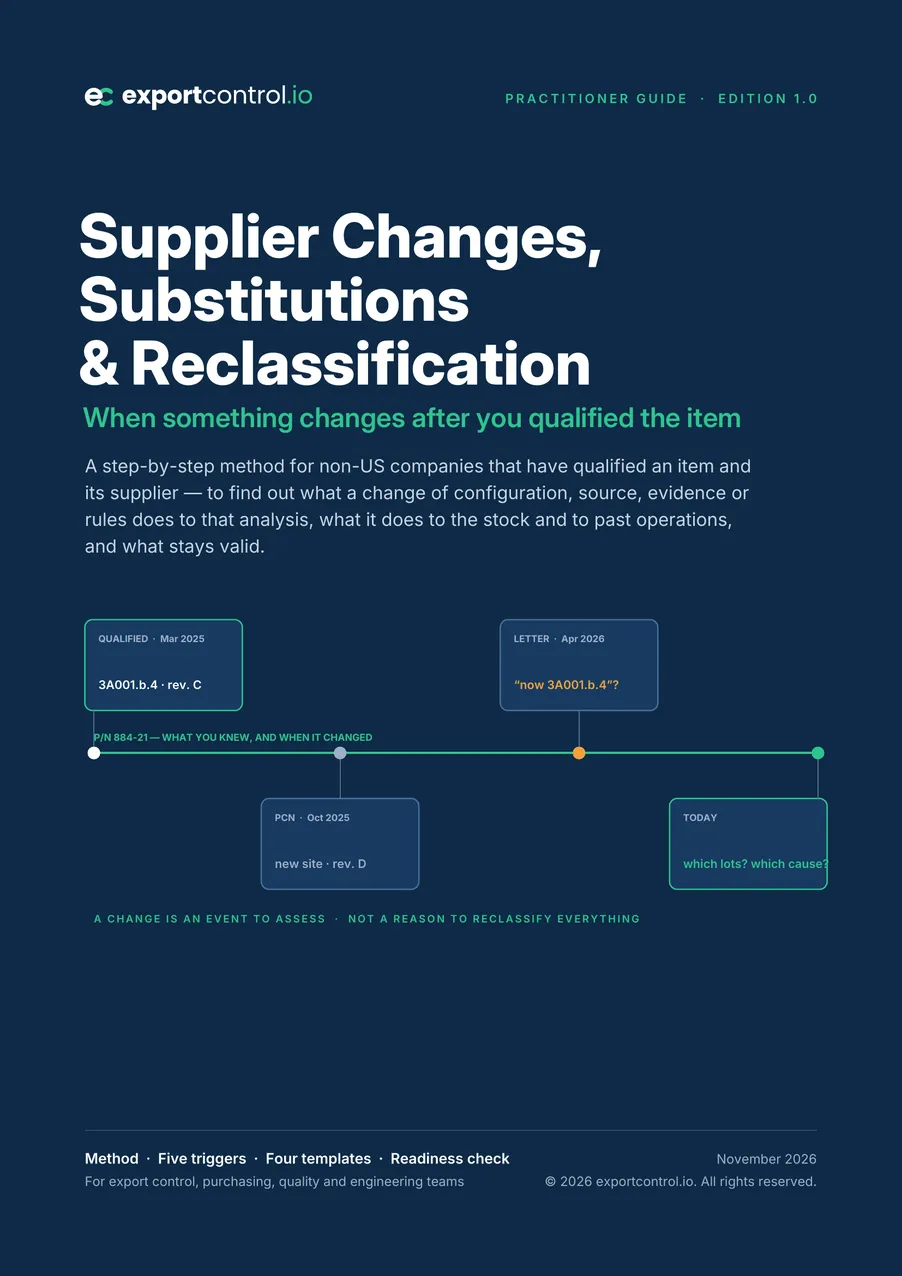
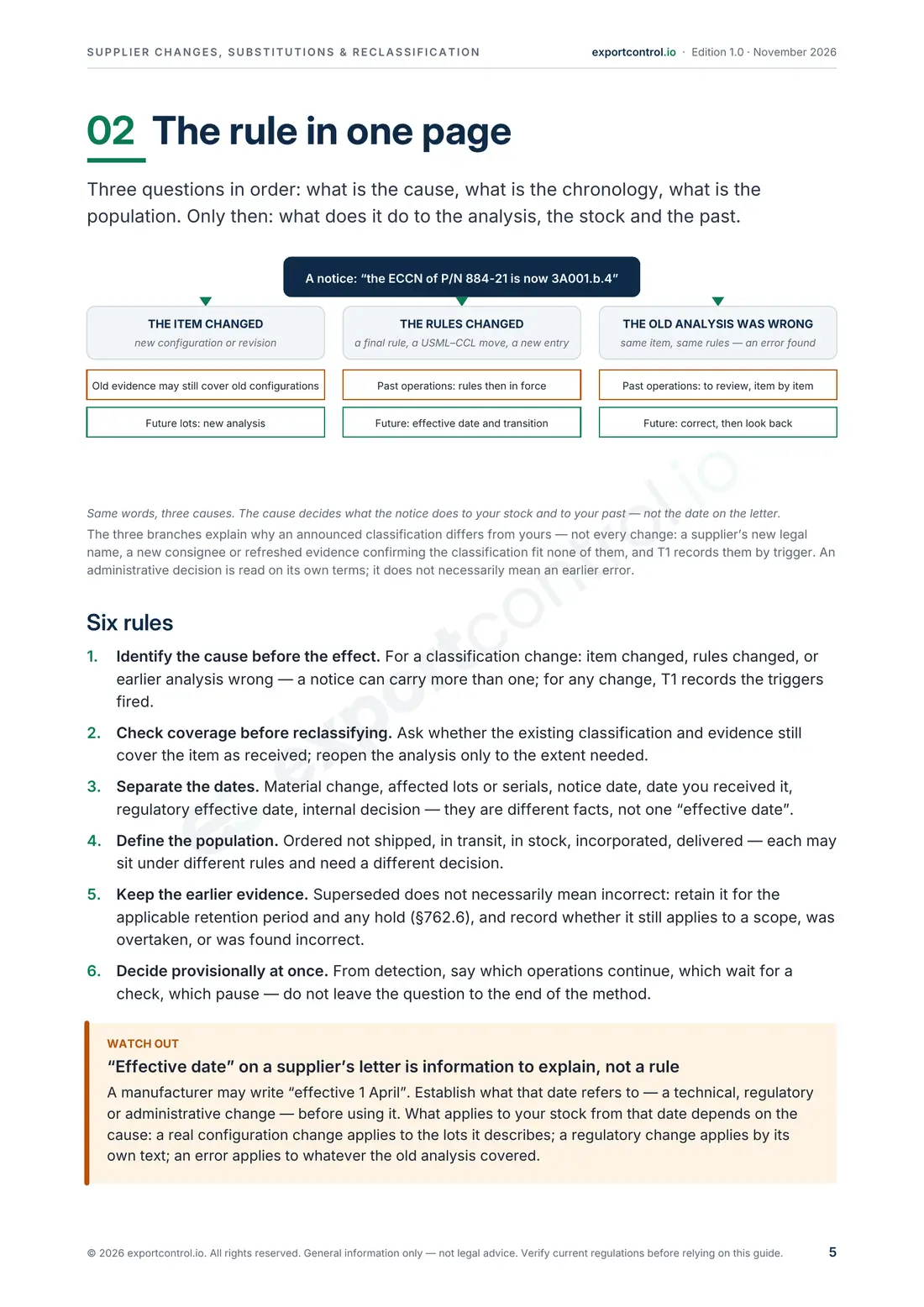
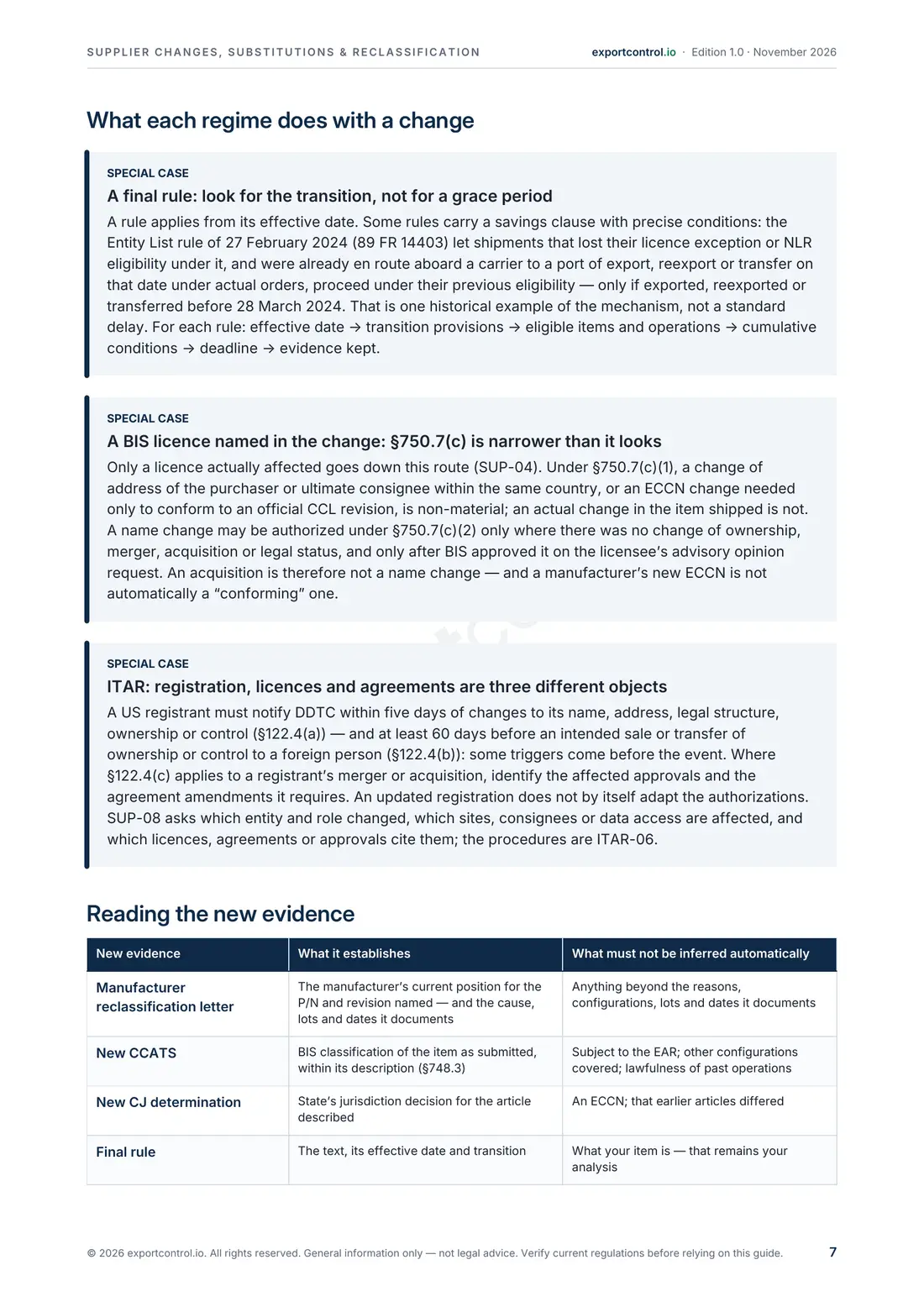
Open an image for the full-size page.
Where it connects
Challenging a Supplier’s Classification
Challenging a Supplier’s Classification contests a classification; Supplier Changes, Substitutions & Reclassification decides what a change does to the file you already have.
ITAR-06Managing Changes
Managing Changes amends the ITAR authorizations themselves; Supplier Changes, Substitutions & Reclassification identifies what a supplier change touches, under the EAR and the ITAR.
Part of a collection
Supplier Changes, Substitutions & Reclassification is one of the eight guides of Suppliers & Procurement (Manage Transactions), available together at €390 instead of €89 each.