CJ-02Edition 1.0 · November 2026
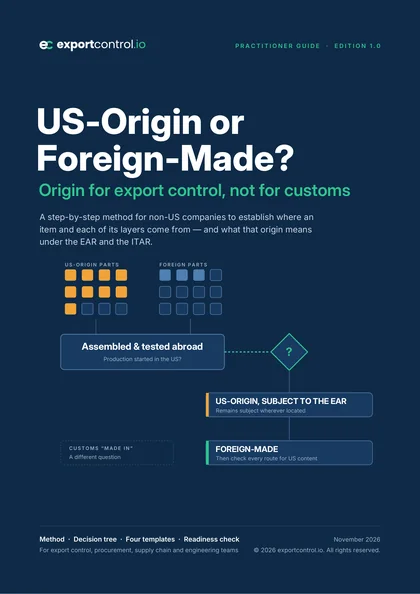
US-Origin or Foreign-Made?
Origin for export control, not for customs
A step-by-step method for non-US companies to establish where an item and each of its layers come from — and what that origin means under the EAR and the ITAR.
What this guide settles
- US origin is sticky: unless excluded by §734.3(b), a US-origin item subject to the EAR remains subject wherever located
- Customs origin answers a different question: substantial transformation is not the EAR test
- Final assembly or testing abroad does not, by itself, create a foreign-made item
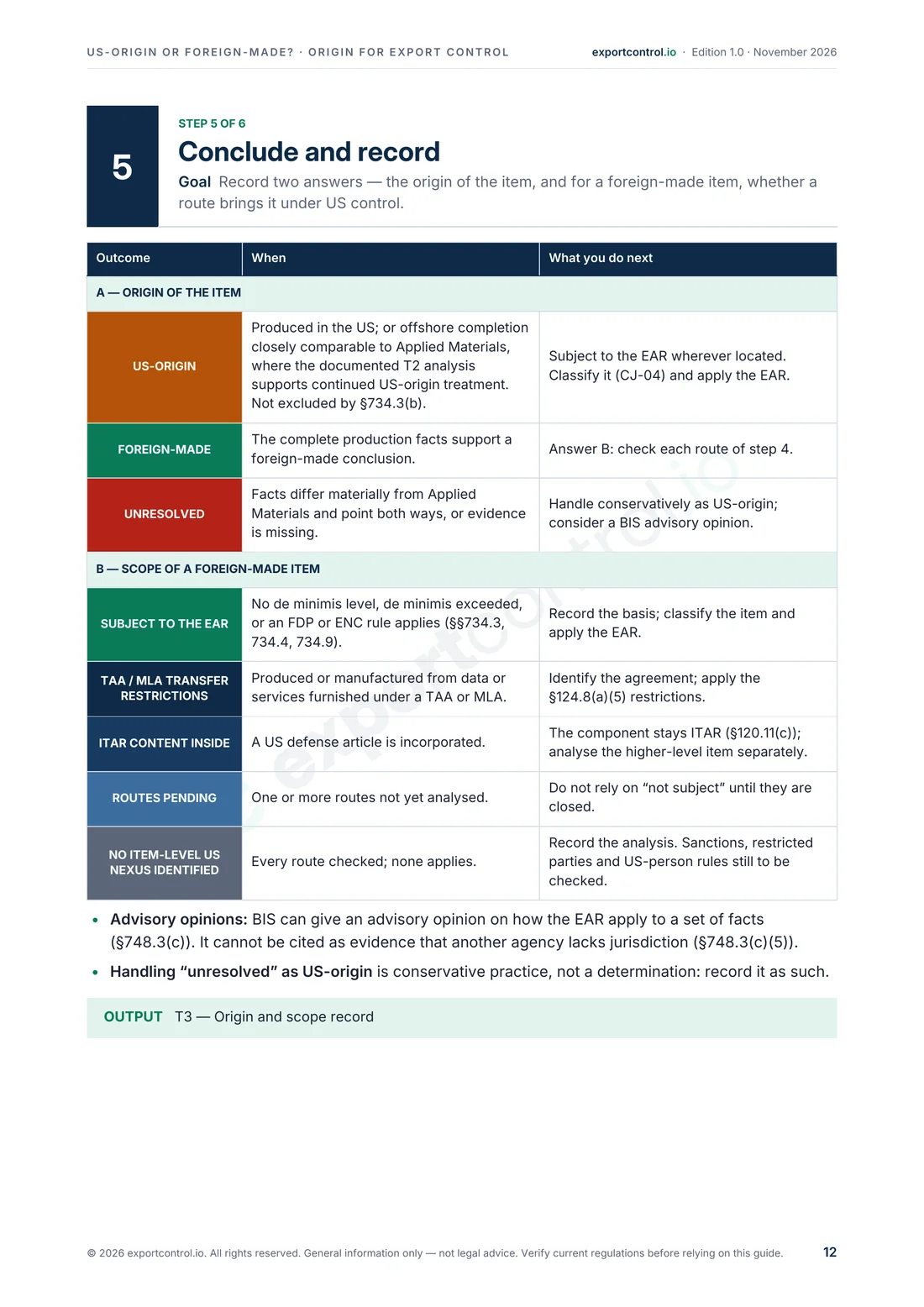
- “Foreign-made” starts the scope analysis: de minimis, foreign direct product rules and ITAR nexus must still be checked
What you get
- The guide: explanations, method, conditions and limits
- Worked examples: eight typical situations, a commented real case and ten pitfalls
- Tools printed in the guide: four templates and a readiness check
- Sources with section references and their verification date
- Revisions included for 12 months
Printed tools: T1 · Origin map · T2 · Origin decision worksheet · T3 · Origin and scope record · T4 · Review triggers · Readiness check
Contents
- Before you start: scope and limits
- Why origin comes first
- The rule in one page
- The words that decide the answer
- The method in six steps
- Templates T1 to T4
- Ten pitfalls
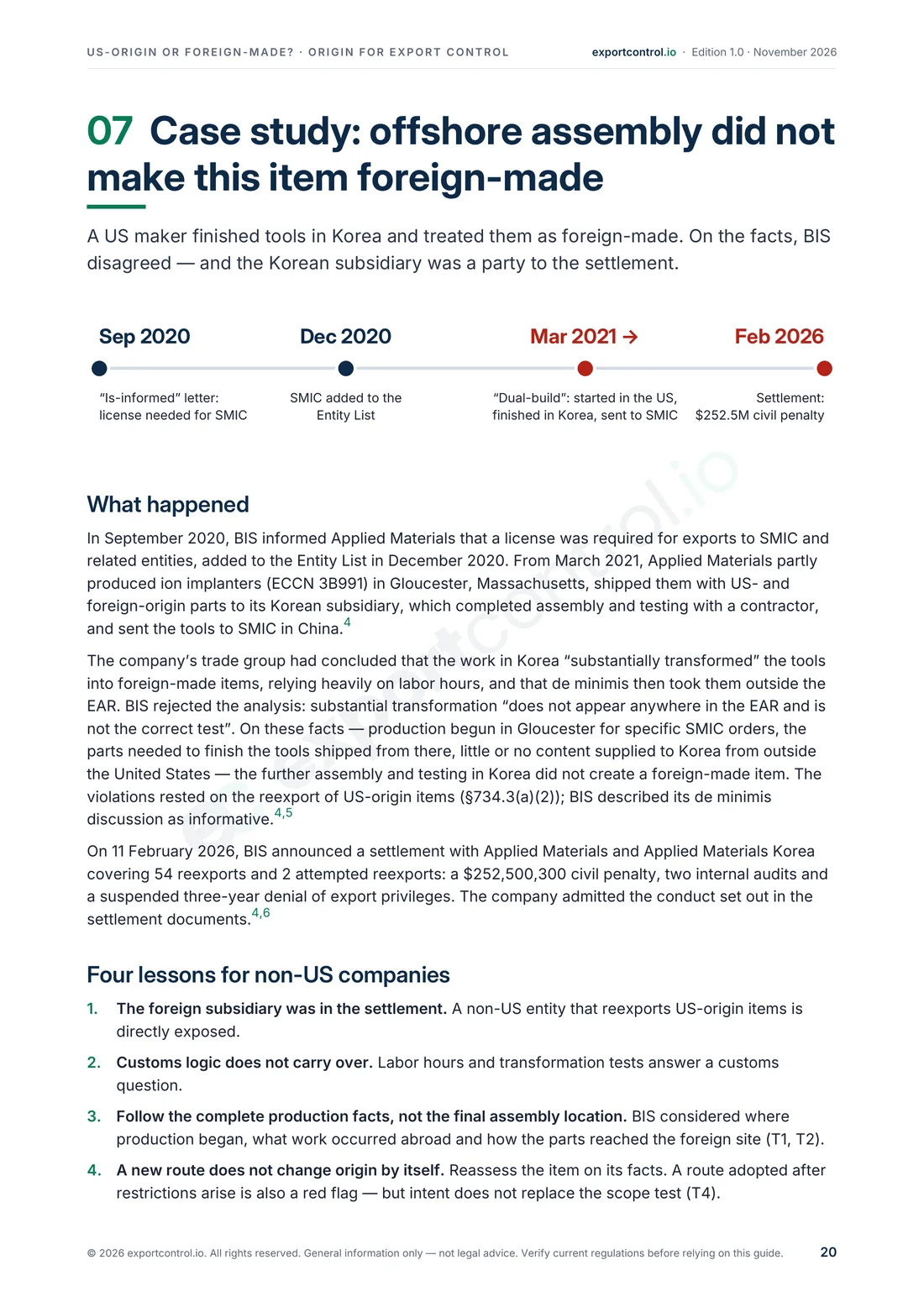
- Case study: offshore assembly did not make this item foreign-made
- Readiness check
What it does not cover
- The de minimis calculation itself, once the item is confirmed foreign-made
- Foreign direct product rules for items made with US technology, software or equipment
- A high-stakes origin call on borderline facts, which needs qualified advice or a BIS advisory opinion
Assumed knowledge. The difference between jurisdiction, classification and scope (ITAR or EAR?), the notions of export, reexport and in-country transfer, and access to the item’s bill of materials and supply chain.
Sample pages
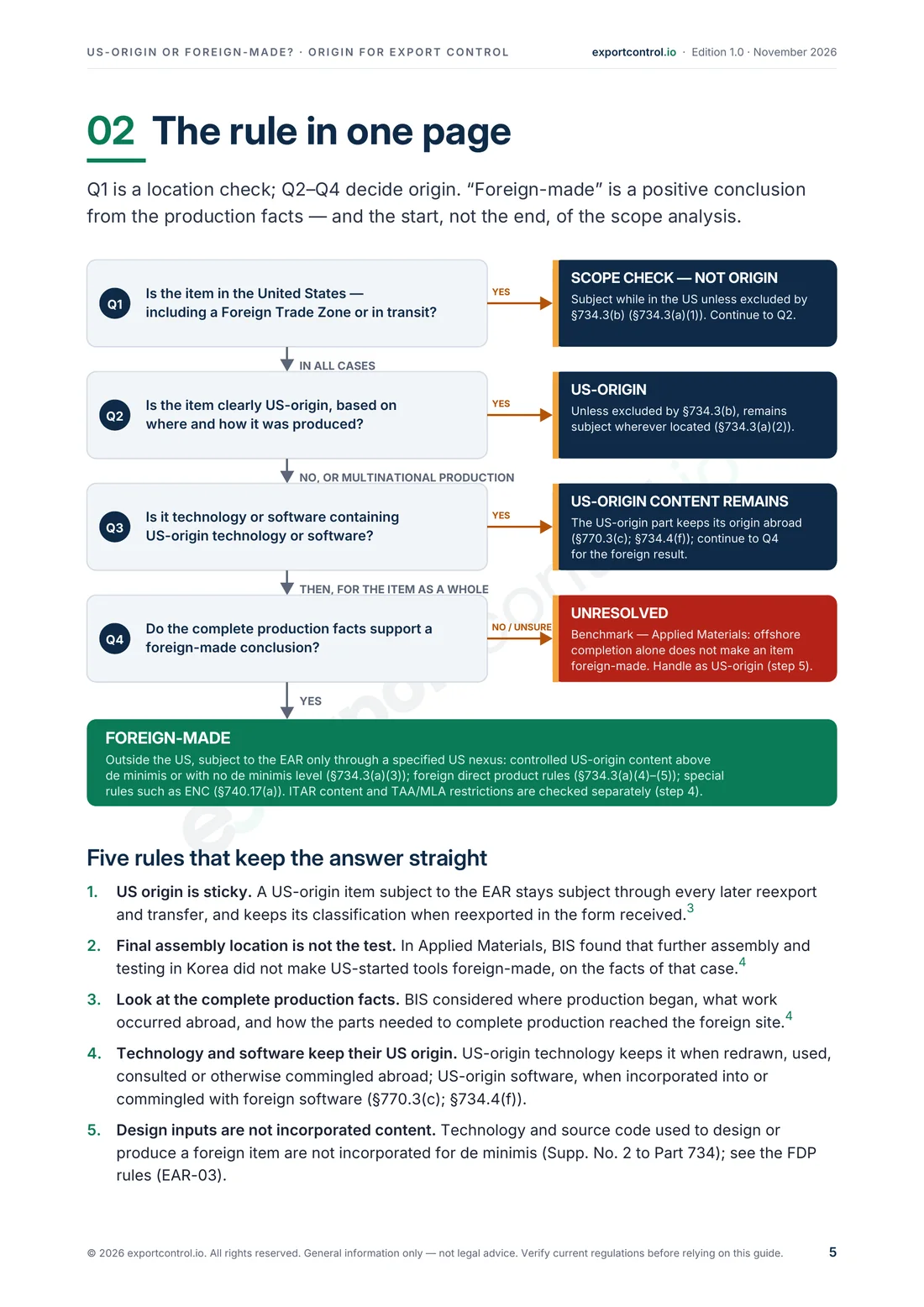
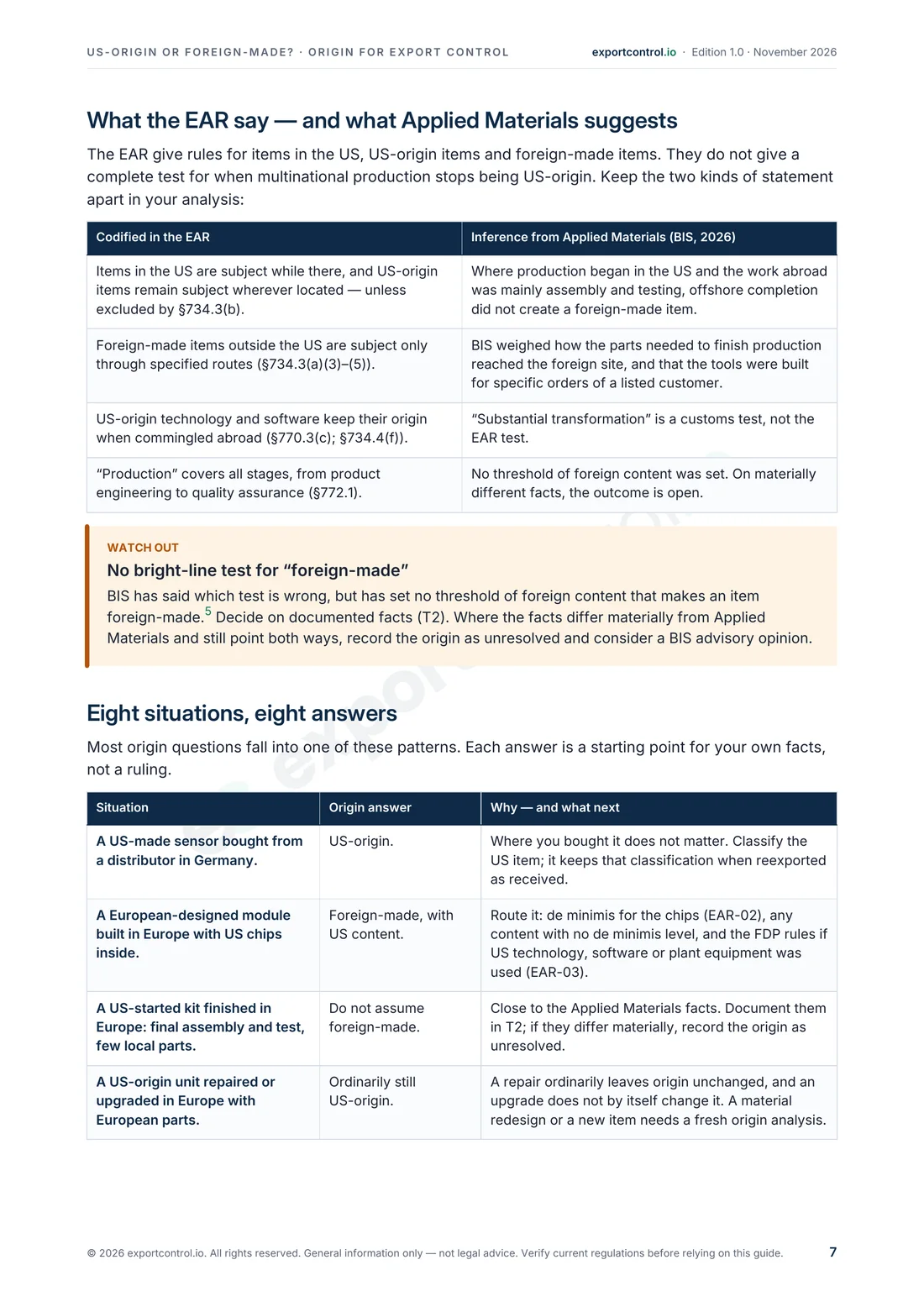
Open an image for the full-size page.
Where it connects
ITAR or EAR?
ITAR or EAR? decides which regime and list an item falls under; US-Origin or Foreign-Made? decides whether a US regime reaches it at all.
EAR-02De Minimis
US-Origin or Foreign-Made? decides whether an item is foreign-made; De Minimis decides whether its US content brings it under the EAR.
Part of a collection
US-Origin or Foreign-Made? is one of the eight guides of Classification & Jurisdiction (Understand the Rules), available together at €390 instead of €89 each.