CJ-01Edition 1.0 · November 2026
ITAR or EAR?
A practical jurisdiction guide
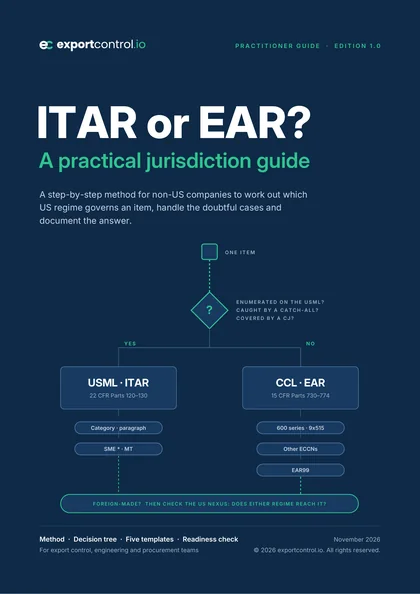
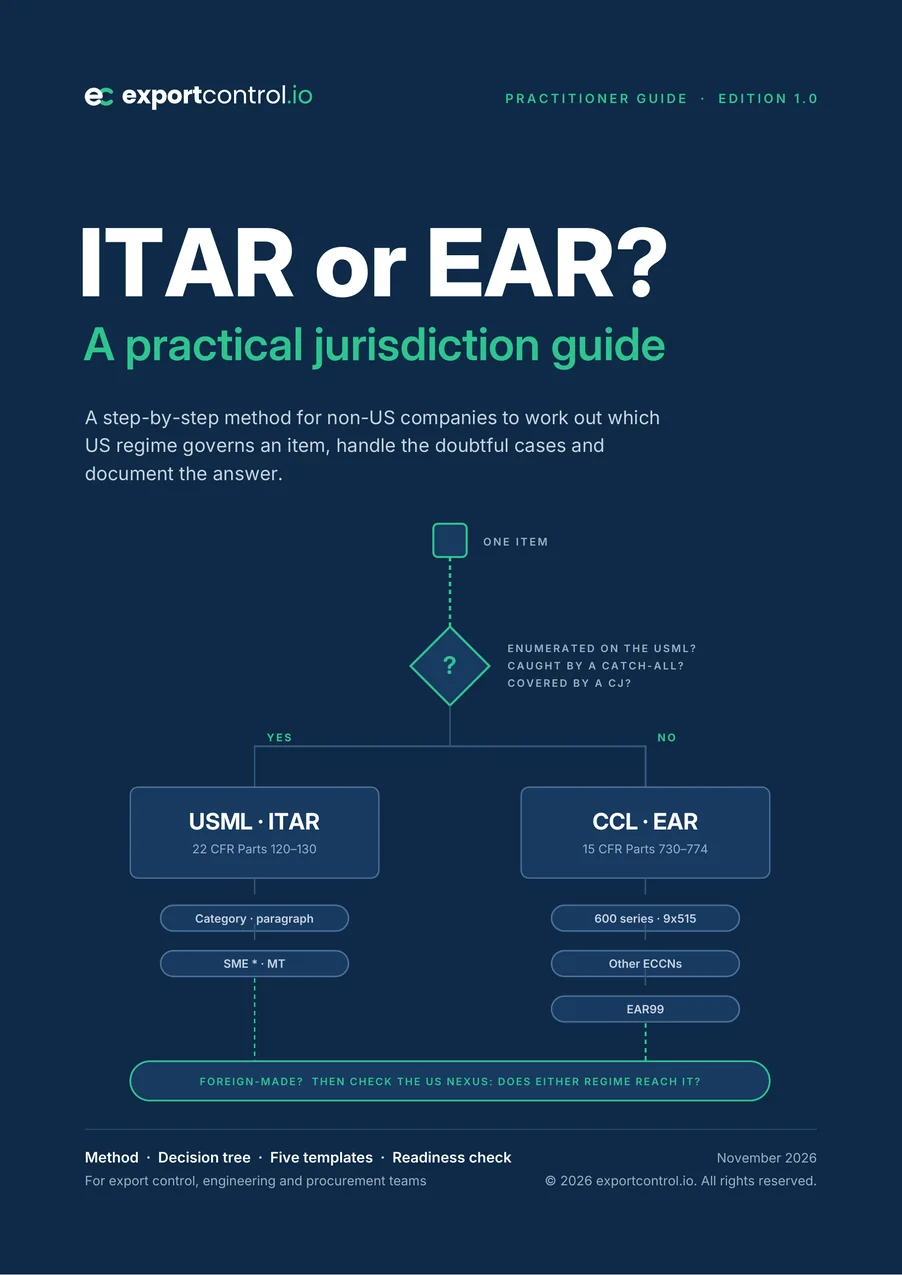
A step-by-step method for non-US companies to work out which US regime governs an item, handle the doubtful cases and document the answer.
What this guide settles
- Jurisdiction, classification and scope are three different questions: which regime, where on the list, and whether it applies to this item at all
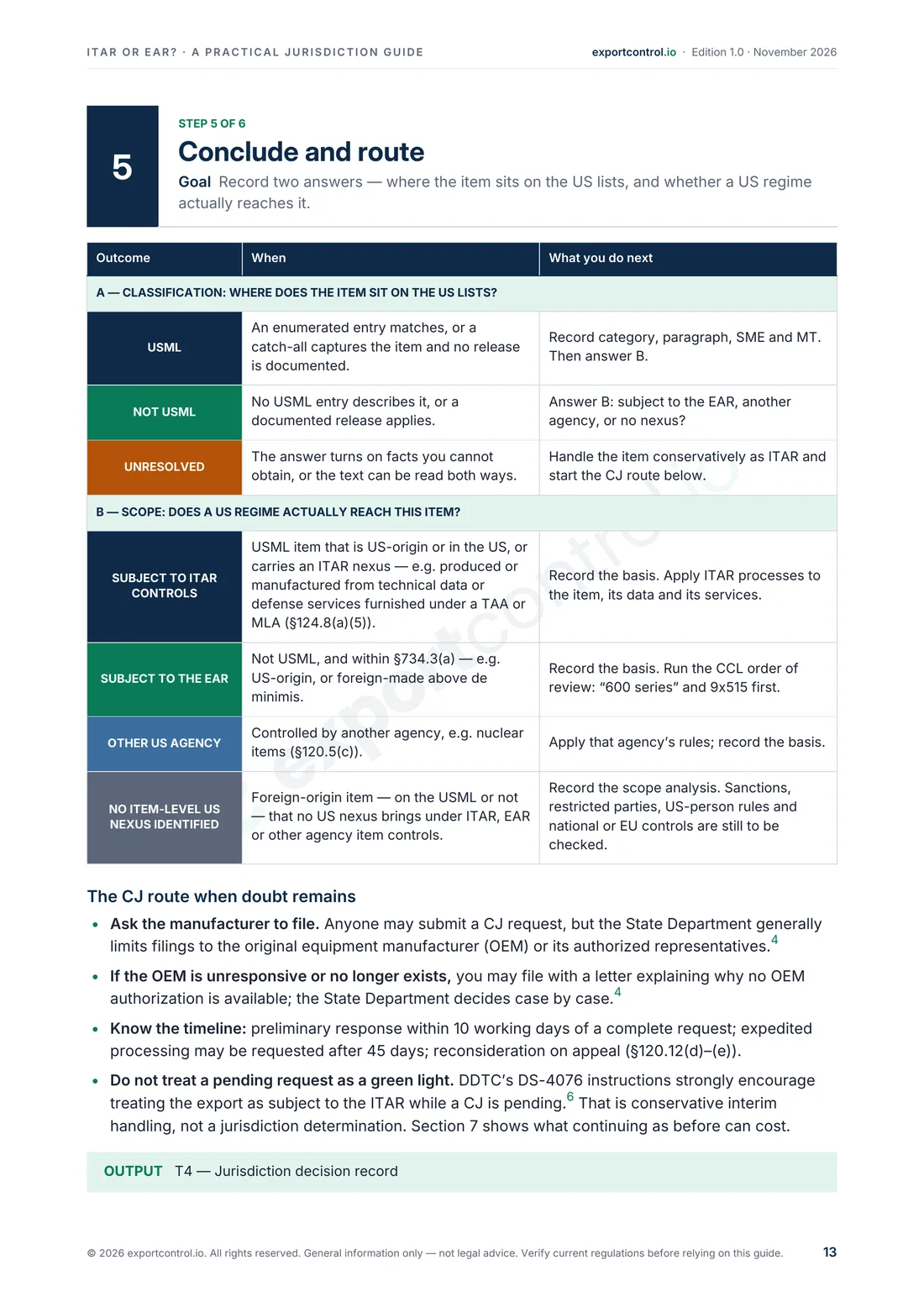
- The USML comes first — enumerated entries before catch-alls — and the CCL only when every answer is “no”
- A DDTC license, an invoice or a CCATS is evidence, not a jurisdiction determination
- While jurisdiction is unresolved, handle the item conservatively as ITAR and start the CJ route — usually through the manufacturer
What you get
- The guide: explanations, method, conditions and limits
- Worked examples: a commented real case and ten pitfalls
- Tools printed in the guide: five templates and a readiness check
- Sources with section references and their verification date
- Revisions included for 12 months
Printed tools: T1 · Item profile · T2 · Determinations and evidence log · T3 · USML and “specially designed” worksheet · T4 · Jurisdiction decision record · T5 · Review triggers · Readiness check
Contents
- Before you start: scope and limits
- Why jurisdiction comes first
- The rule in one page
- The words that decide the answer
- The method in six steps
- Templates T1 to T5
- Ten pitfalls
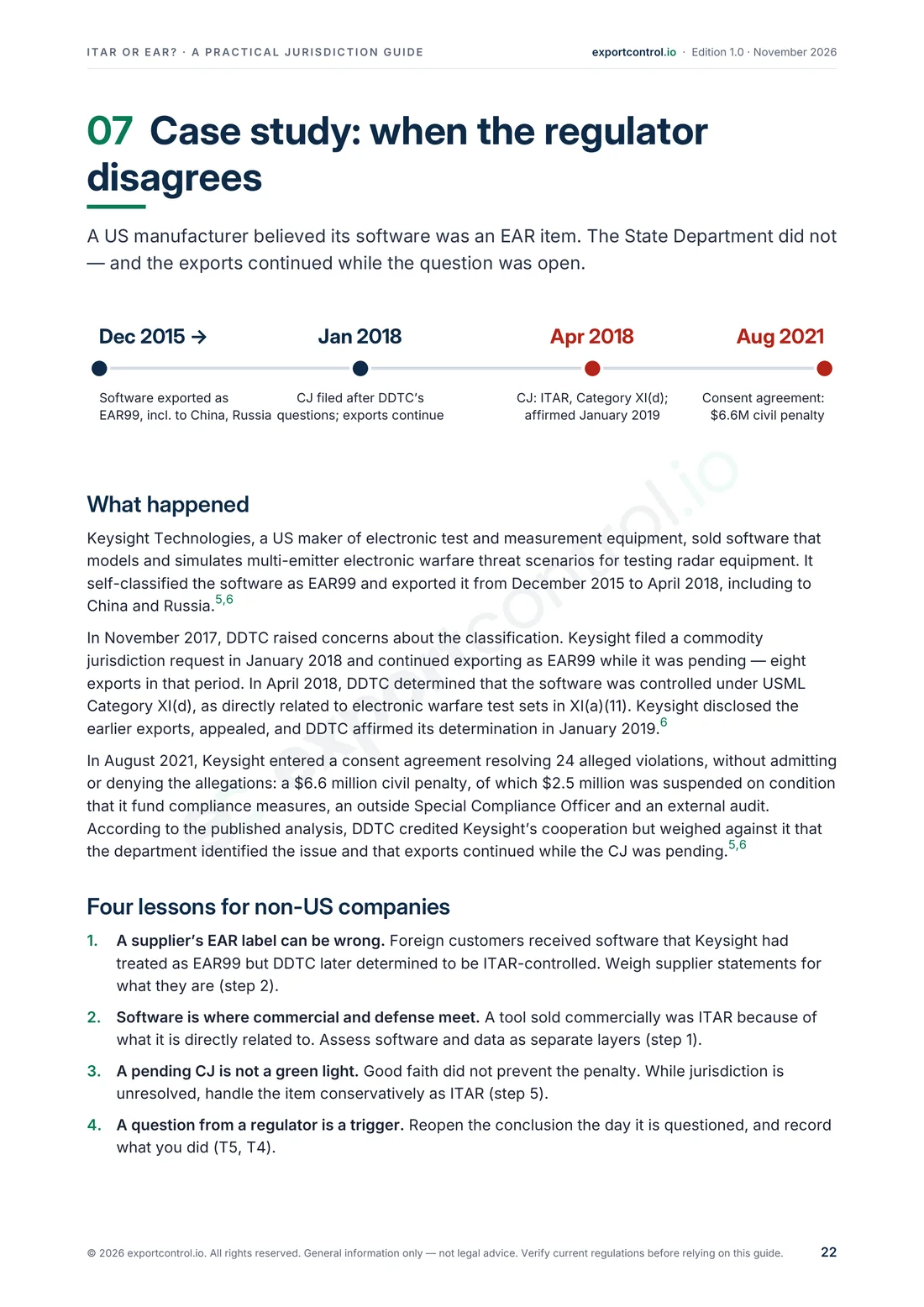
- Case study: when the regulator disagrees
- Readiness check
What it does not cover
- A developer who will not engage, when the outcome turns on a development history you cannot document
- A full scope analysis of a foreign-made item: de minimis, foreign direct product rules, US nexus
- Other US controls: items under another agency’s jurisdiction, OFAC sanctions and transaction-specific restrictions
Assumed knowledge. The notions of export, reexport and retransfer, and where to read the current USML (22 CFR Part 121) and CCL (15 CFR Part 774). Access to the item’s engineers or supplier helps.
Sample pages
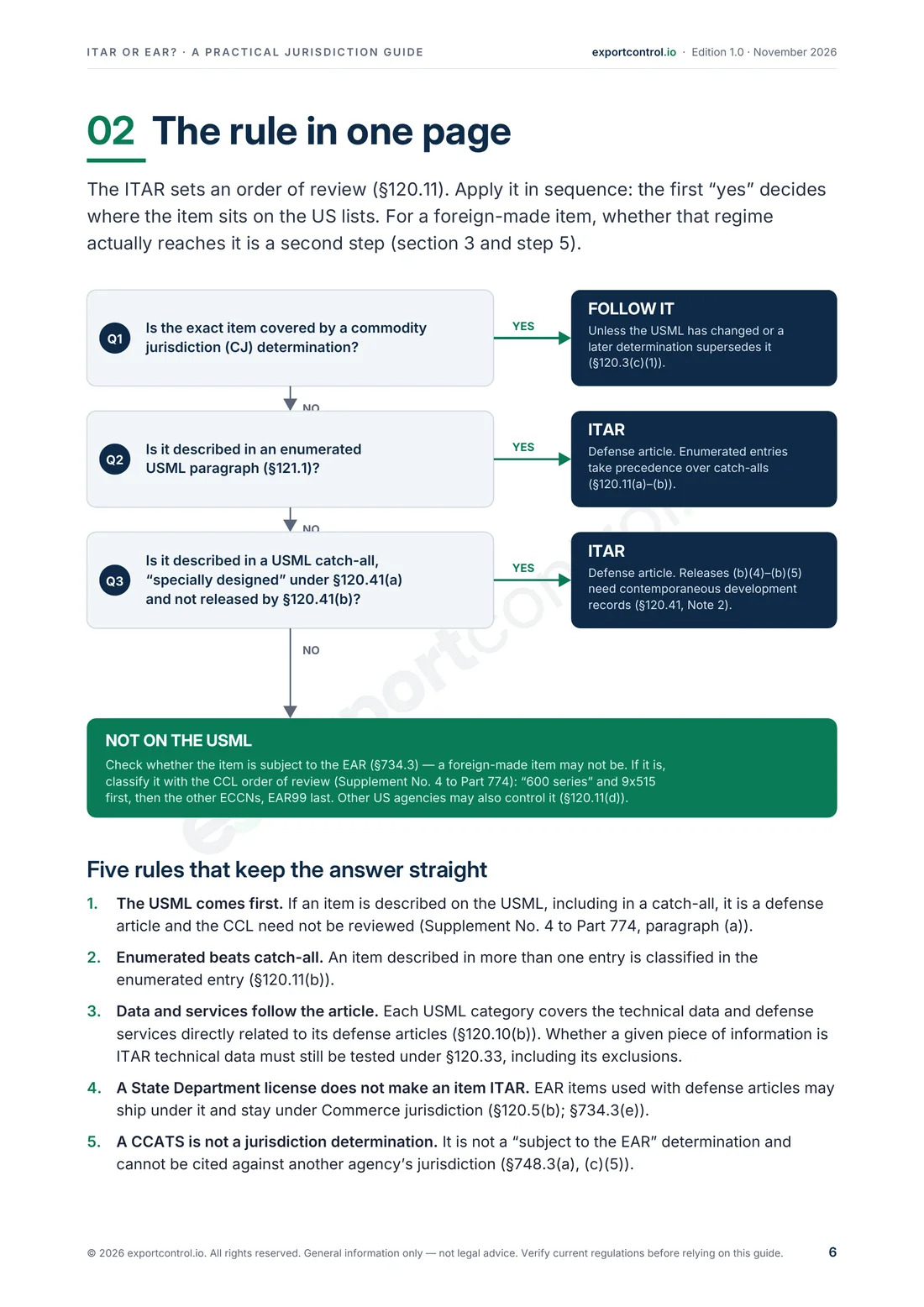
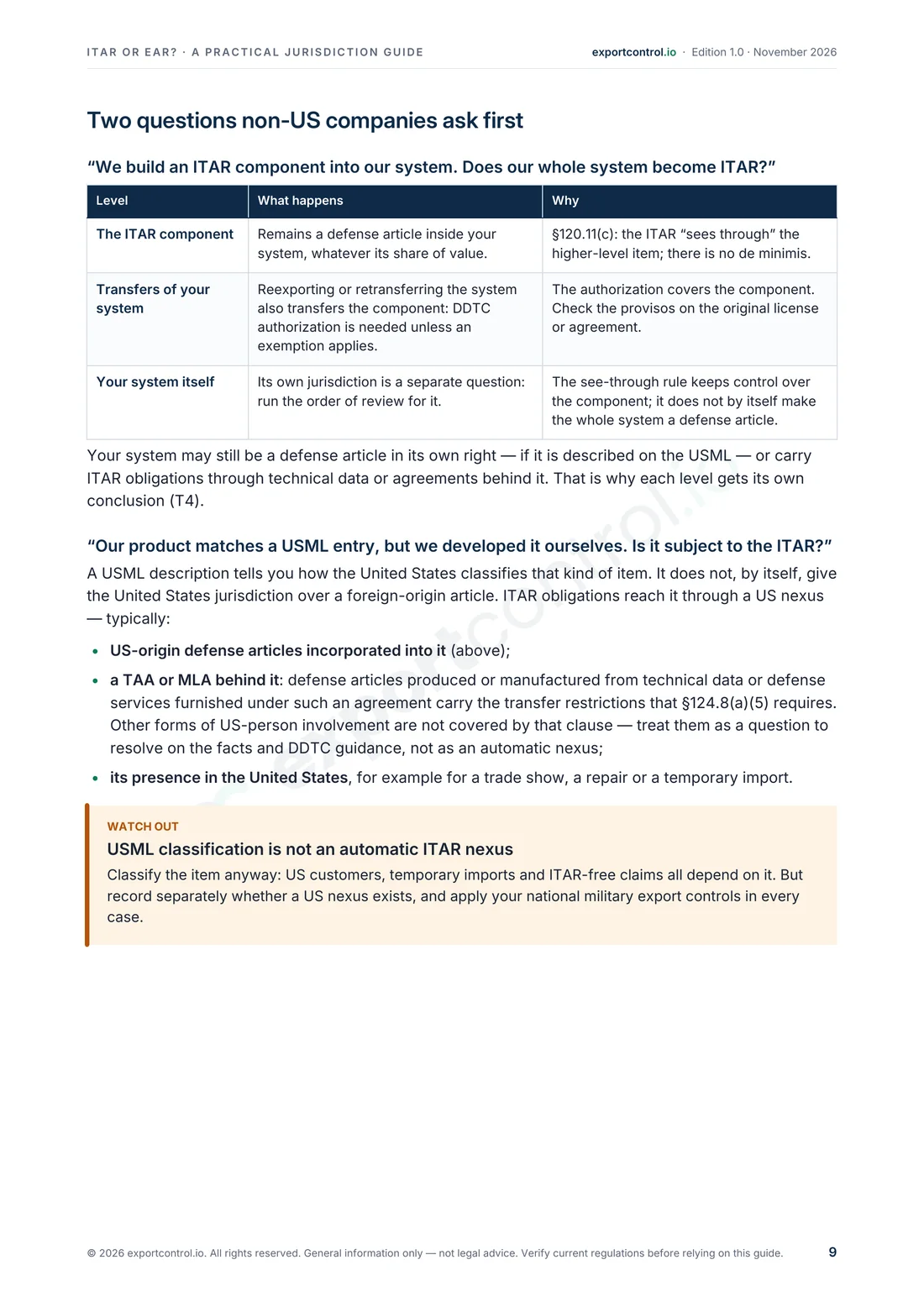
Open an image for the full-size page.
Where it connects
US-Origin or Foreign-Made?
ITAR or EAR? decides which regime and list an item falls under; US-Origin or Foreign-Made? decides whether a US regime reaches it at all.
CJ-03Reading the USML
ITAR or EAR? runs the whole order of review; Reading the USML goes deep on reading one category, paragraph by paragraph.
CJ-06CJ vs. CCATS
ITAR or EAR? is your own analysis; CJ vs. CCATS is how to ask DDTC or BIS when doubt remains after it.
Part of a collection
ITAR or EAR? is one of the eight guides of Classification & Jurisdiction (Understand the Rules), available together at €390 instead of €89 each.